The First National Bank Building
In June 1907, W.B. Crump of Wynnewood established the First National Bank in Blanchard and set up temporary business quarters in one of the general merchandise houses (it is unclear which one [possibly T.C. Wood & Co.]). Crump brought F.J. Stafford as the new bank's Cashier, whom he had employed at his Wyneewood mercantile store.
In the fall of 1907, Crump purchased a commercial lot at the northwest corner of what is now Broadway and Main and formulated plans for a new 2-story brick building with a single-story office structure in the rear, facing Broadway.
As soon as building materials were received, construction commenced on the new building almost immediately. The ground floor of the new structure, which was completed in early 1908, was planned for and became the permanent home of the recently formed First National Bank.
The second floor of Crump's new building was arranged as office spaces and, over the years, was the location of all kinds of businesses. It housed dentist's and doctors' offices. Dr. W.S. Hames, Physician and Surgeon, had his practice up there for a time. Dr. Love also occupied an office upstairs.
In July 1908, W.E. Greenwood was granted Blanchard's first telephone franchise by a special election. In October of that year, he leased the office space over the First National Bank, formerly occupied by Dr. Love,[01] where he installed the telephone exchange.
The single-story structure in the rear (facing Broadway) comprised two office spaces. In April 1913, F.M. McFall leased both areas and moved his Blanchard Record newspaper there (from R.E.L. McLain's store and post office). Many types of businesses have been located in this space through the years. Long after The Blanchard Record closed, Lucy West opened a delicatessen (cafe`) here in October 1939. In more modern times, these spaces were used for beauty salons, barber shops, etc.
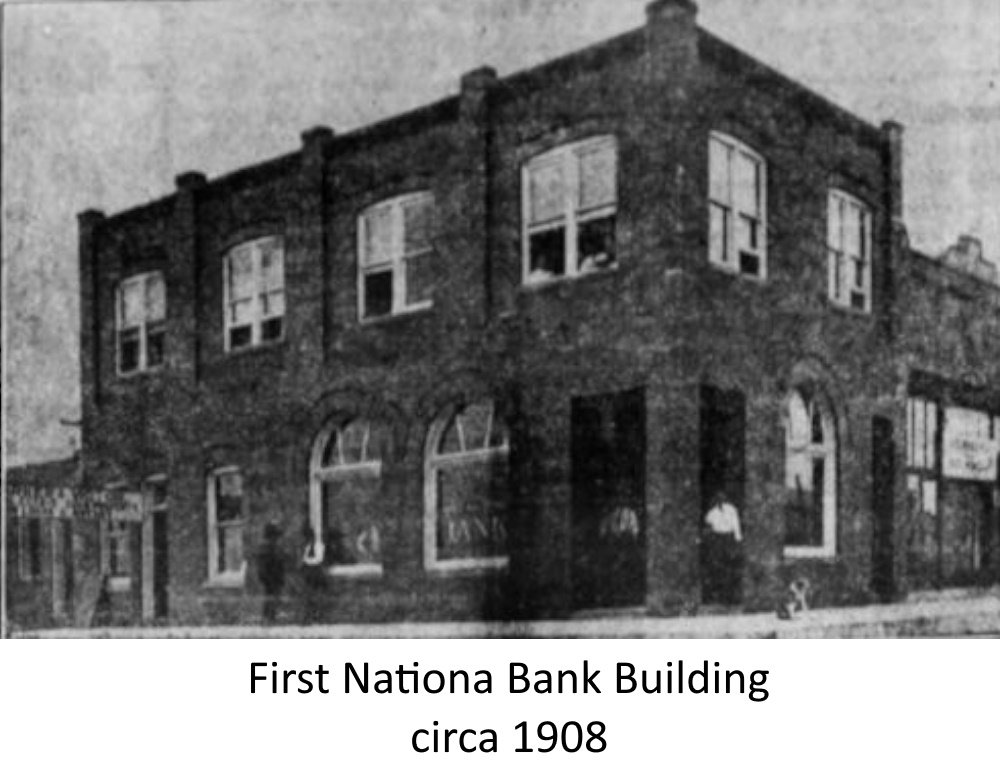
In March 1938, workers applied a new coat of stucco to the bank building, changing the appearance from brick to a bright white.
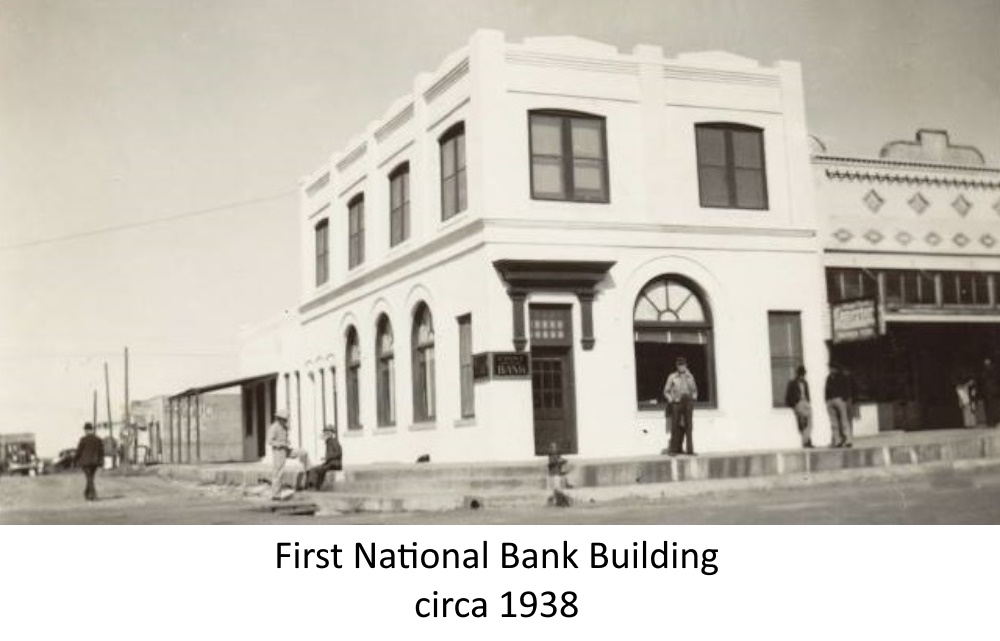
In April 1954, the First National Bank merged with the First State Bank, and the portion of the building used by the bank was vacated. Then, in November 1955, the Blanchard post office moved into the space formerly occupied by the bank.
In 1964, a new post office building was built at the southeast corner of Main and N.E. 3rd (where the Blanchard News is now) and was dedicated in February 1965. The First National Bank building was vacated again.
In December 1966, the First Methodist Church opened a youth (recreation) center in the old bank/post office. It is unknown when the youth center closed, but in 1973, a Chickasha man, Donald Lerch, established a crystal manufacturing plant here.
It is unclear how this building has been used since the crystal plant closed and what is there currently.
The Stafford Building
F. Joe Stafford came to Blanchard in March of 1907 when the First National Bank was established to take the position of Cashier. He had been employed in previous years by W.B. Crump, founder of the National Bank here, in the mercantile business in Wynnewood. In 1908, Stafford purchased the lot on the southwest corner of Main and Highway (123 N. Main) and, in August of that year, began construction of a 2-story brick building with dimensions of 25' x 80'. When the building was completed in February 1909, Marion Haskin partnered with First National Bank president J.M. Gordon and established a general mercantile business on the first floor.
The Masons organized in March 1909 and set up their lodge on the second floor of the Stafford Building. In addition to the Masonic Lodge, several other offices were on the 2nd floor in the early years. Among these offices were Parker, McDonald, and Victor Real Estate; George W. Bowing, Surgeon and Dentist; Parker and Morgan Real Estate; Dr. Shi and Nolan, Physicians and Surgeons.
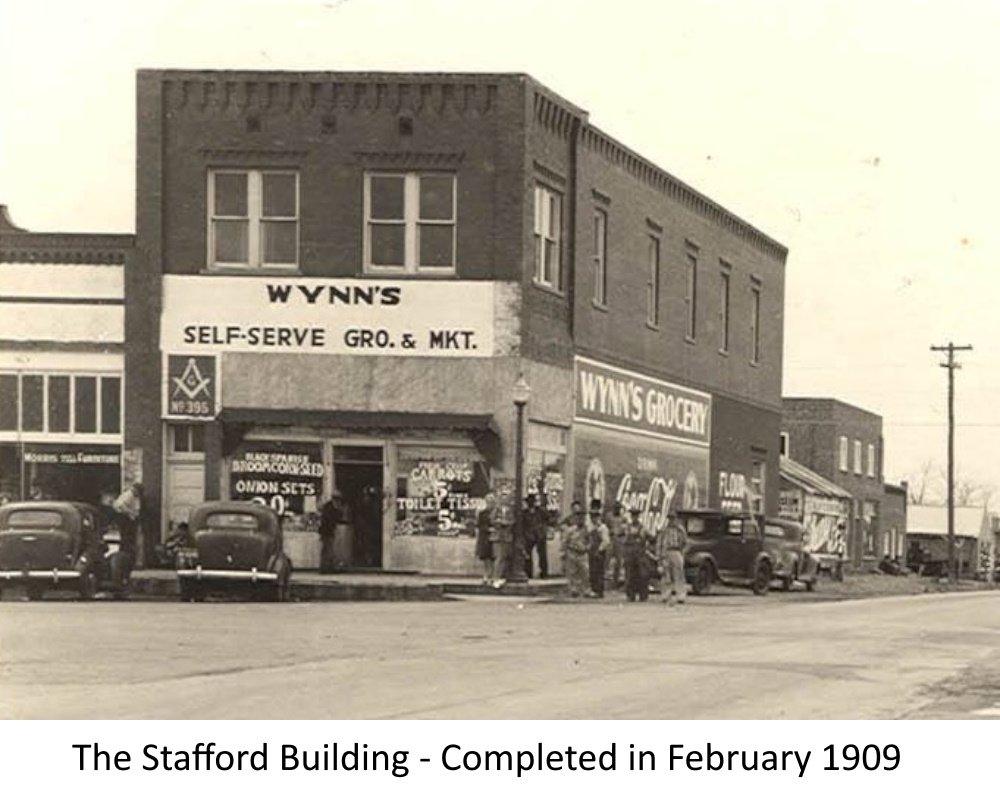
It is unknown what was at this location before W.L. Bowser moved his store here in March 1939. Bowser and Son (Lloyd) had their dry goods and grocery business here until Pat Wynn purchased the store in 1945. The Wynns operated a grocery store at this location until 1956. At some point after 1956, Joe G. Humpries expanded his plumbing, electric, and appliance business, which was occupying the building next door south, to this space. And then, in February 1968, Mr. and Mrs. Russell Olds opened an OTASCO (Oklahoma Tire & Supply Company) franchise in this building. Present-day, it is the home of a Subway[02] sandwich shop.
Blanchard Town Hall and Courthouse
According to A.J. Terrell's The History of Blanchard, Oklahoma, On February 10, 1908, an election proclamation was issued, calling an election to vote a bond issue of $4,500 to build a city hall. The election carried and In June 1910 the town council, in a special session, adopted plans prepared by architect T.J. Galbraith of Chickasha, for a new town hall. At this point in our town's history, our town was in urgent need of an adequate courthouse and city hall. One reason for an immediate need was that the Northern District Court was established, whereby McClain County was divided into two sections for legal matters for the convenience of the citizens, and Blanchard became the seat for the northern district. Another reason was that the city fathers had aspirations of Blanchard becoming the state capital. They thought that Blanchard had as good a chance as any other town except Oklahoma City. The northern district was disestablished in the late 1920s and combined with District One in Purcell.
During the following week, contractors in the region were invited to submit proposals to the office of Trustee, A.J. Grayson to erect a one-story brick courthouse. In due time, A.W. Bennett of Purcell was awarded the contract.
The July 28 edition of The Blanchard Record reported that work on the courthouse was progressing nicely, and foreman W.A. Brooks informed that the work would be rapidly pushed to completion. Then, in the August 18 edition of The Record, it was reported that work had been slowed considerably owing to delays in necessary material shipments.
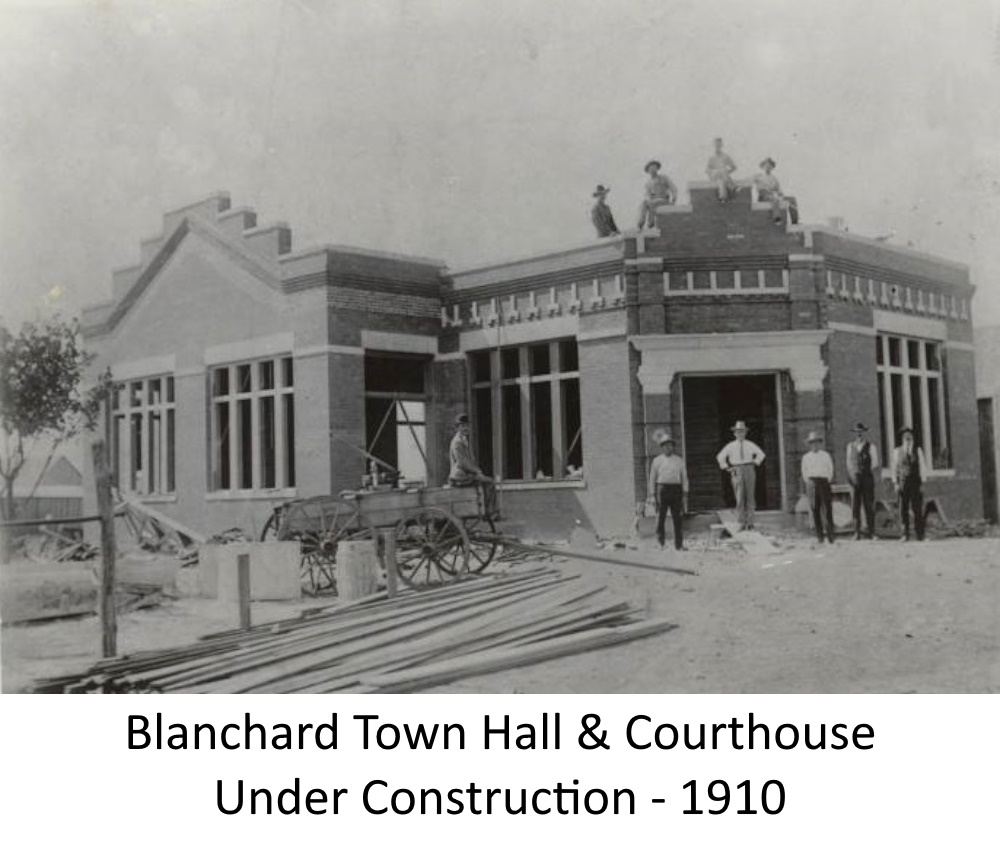
It was reported in the November 24 edition of The Blanchard Record that the courthouse had been completed and accepted by the town board, and on December 28, The Minco Minstrel reported that the new city hall at Blanchard had been completed and judging by a picture in The Record, it was designed for use as a capital building when Blanchard gets the capital.
Blanchard entered the race for the state capital and, at one point, offered a free site for the capital building and a bonus of $100,000——or more if necessary. Blanchard must have been a profoundly confident little city but obviously, it wasn't selected as Oklahoma's chief city.
The Texaco Service Station at Highway and Jackson
The construction date of this building remains unknown. However, newspaper accounts indicate that in 1948, Jim Williams managed a Texaco service station at this location. In July of that year, Williams transferred ownership to Ike Whitford. Interestingly, by November of the same year, Williams established a new Texaco station at the northwest corner of Main and Highway 62.
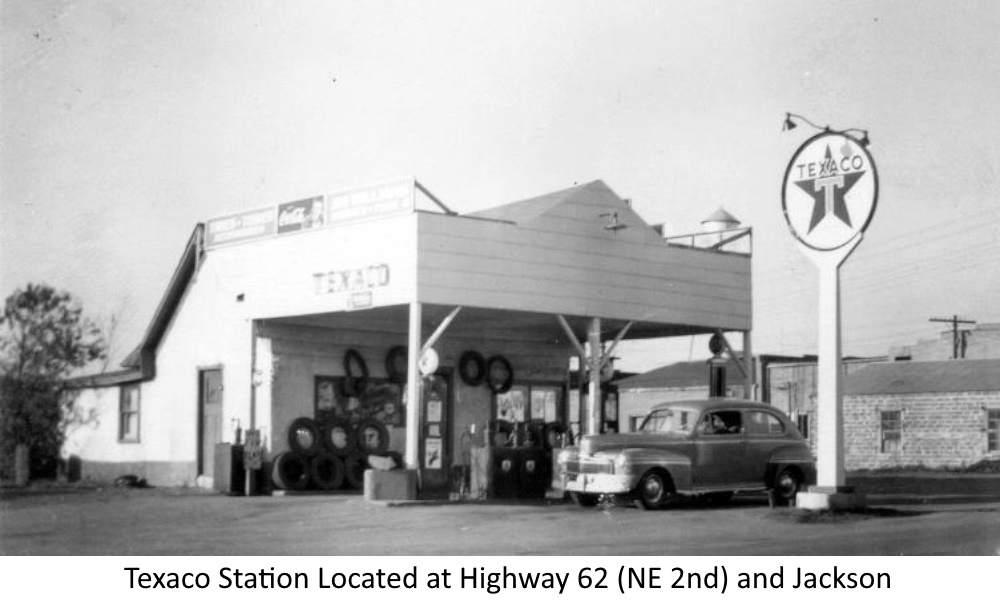
A significant transition occurred in January 1952 when the Texaco station became a Mobil station. This change came about because Ike Whitford entered into an agreement to distribute Mobil products, effectively severing all ties with Texaco in the process.

In January 1954, Ike Whitford transferred ownership of the Mobil station to John Hale. Later that year, in November, Hale sold the station to Bruce Swanson.
Come October 1959, Bruce Swanson demolished the old Texaco station building and in its place, he constructed a modern Mobil station and service center.
In September 1960, Bruce Swanson sold the Mobil station to Bob Wingate. As the years went by, the Mobil station experienced a series of transitions in ownership, with different individuals taking the reins at various points. Eventually, the Mobil building was demolished and is now the location of the Washtown Carwash.
Gene Daniels Produce
The exact founding date of Gene Daniels Produce is unknown, but newspaper accounts indicate its presence in the early to mid-1950s. In April 1954, Mary Daniels, Gene's wife, assumed management of the Blanchard tag agency, succeeding Bob Gilmore. Initially, she operated the agency from this site but later relocated it to 112 North Main where she also established a dry goods store.

Ritz Theater
According to Harreld Kenneth Howell, the son of Pearl Howell, the Ritz Theater opened in 1928. Prior to 1928, Charlie and Addie Francis had a theater on the southwest corner of North 3rd and Main. Norvel Joe Moore said that Ernest L. "Doc" Biggerstaff was the first to operate the Ritz, but the Biggerstaffs didn't come to Blanchard until about 1932.
Doc and Glenna Biggerstaff sold the Ritz to Mrs. Avece Waldon of Lindsay in September 1943. Mrs. Waldon was the sister of Charlene Ellerd (Truman's wife). Having been in the theater business in Oklahoma City, Truman took over management of the show. The Ellerds eventually acquired ownership of the theater and ran it until sometime in 1959.
In March 1961, Mr. and Mrs. David Hill purchased the Ritz and reopened it after it had been closed for about two years.
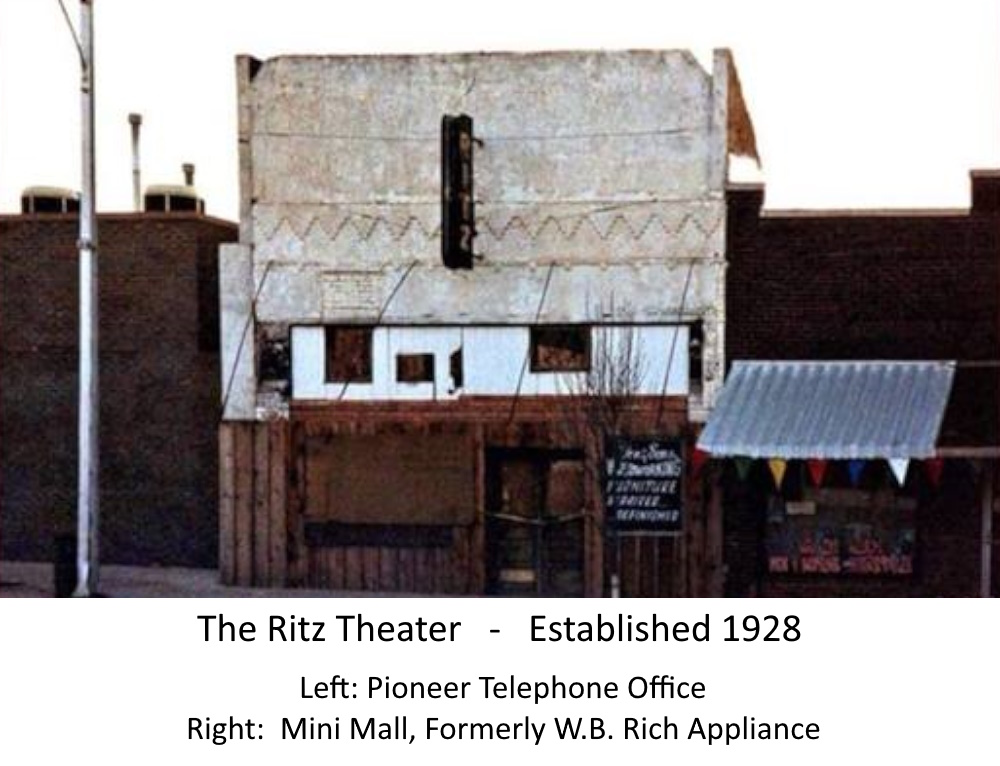
The closing of the Ritz[03] as a movie theater by the Hill family was not documented in the Blanchard paper. However, in July 1975, Ronnie Kaye of WKY Radio [] transformed the space into 'The Scene.' Subsequently, the property was acquired by Don Standridge, who operated a woodworking shop there with his son. Tragically, on January 18, 1987, the building was destroyed by fire. Standridge then sold the remaining structure to Norval Joe Moore. Norval Joe, in turn, sold the lots to Pioneer Telephone Cooperative, Inc. Pioneer transformed the area next to the street into a rest area with park benches and tables that exist there today.
The Barber Hotel and Livery Stable
In early 1907, C.A. Barber built a two-story frame hotel at South Main and S.E. 9th Street (present-day S.E. 2nd). The Barbers began operation of their new hotel on May 1, 1907. In July 1907, the Barbers added a livery stable adjacent to the hotel. Unfortunately, in March 1910, a fire started in the livery stable and spread to the hotel, burning both structures to the ground. According to newspaper accounts, all the animals housed in the stable were saved.
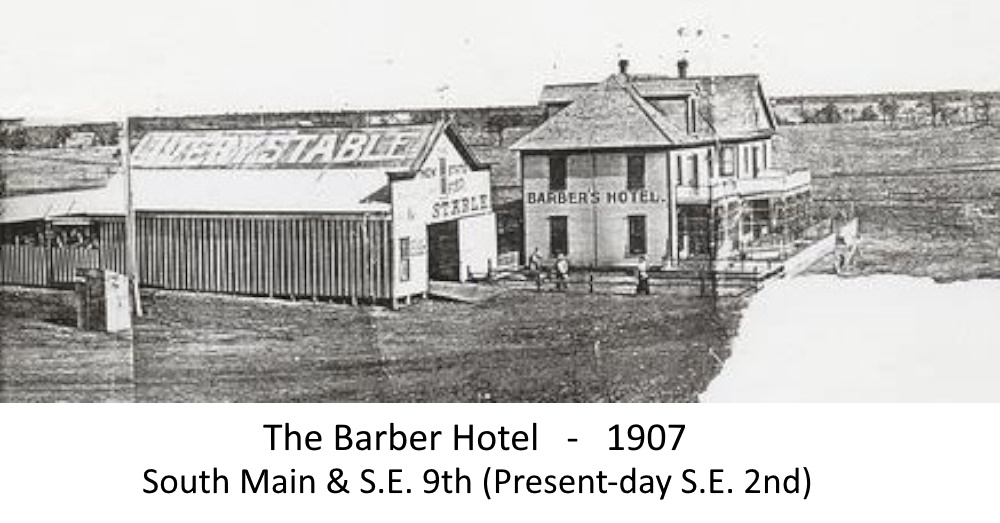
Mr. and Mrs. Barber completed the construction of a new brick hotel in June 1910 and occupied it in the week of June 21, 1910. It was located at present-day 224 N. Main. At some point, the Barbers sold their hotel to Jacob and Louisa Jane (Garland) Peters.
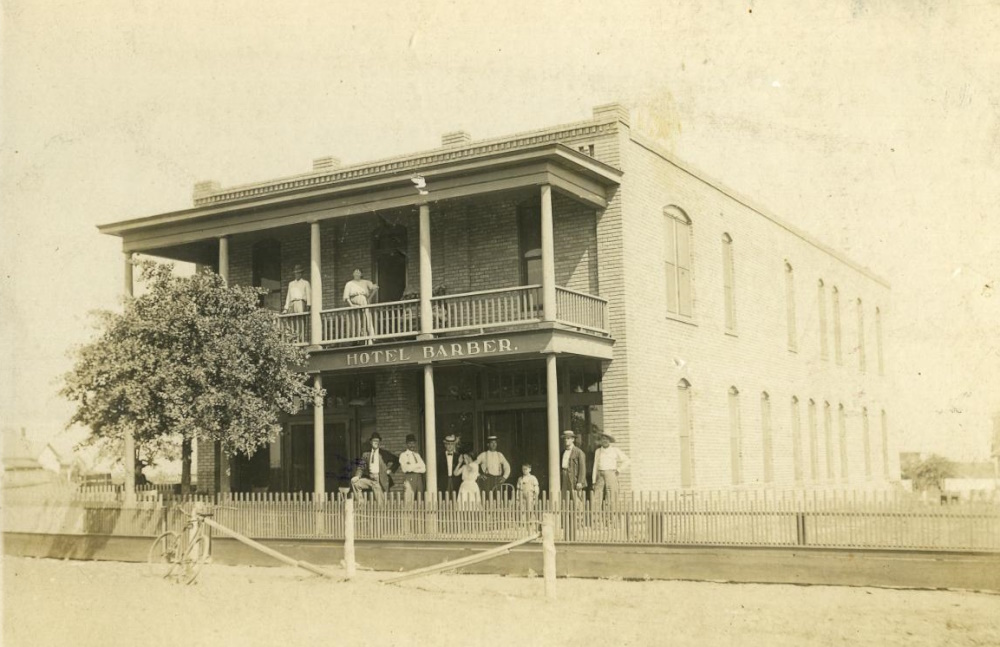
The Peters' Hotel
The Peters Hotel was a landmark in Blanchard and had several owners over the years. The Peters ran it for some fourteen years. The last owners were Dr. and Mrs. I.N. Kolb. After the death of Dr. Kolb, Mrs. Kolb sold the hotel to the First Baptist Church. In the fall of 1957, the church body razed the old hotel building and salvaged the lumber and brick to use in the construction of their new auditorium and educational center on North Jackson. The church traded the hotel lots to Rex and Mary Curry for lots that the Currys owned adjacent to the old Baptist church building.
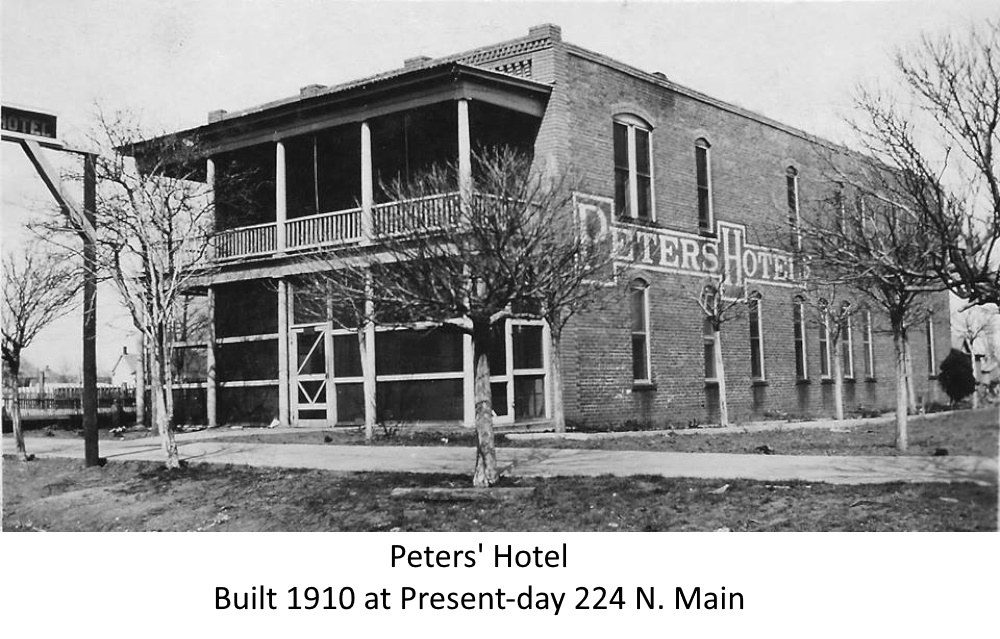
After the hotel was torn down in 1957, the lots laid bare until the postal service leased the lots and built a post office building dedicated in February 1965.
The First Methodist Church
The Methodist Church in Blanchard was founded in January 1907. The congregation initially met in various locations, including the Blanchard Hotel, the Carter Building, the Town Hall, and the Presbyterian Church. In November 1912, the church purchased lots at 521-523 North Main Street, where a one-room frame building was completed in 1914.
The first pastor was Rev. E.D. Parish and the board of trustees comprised J.J. Morgan, William Morgan, J.J. Scribner, J.C. Bond and J.B. Bond.
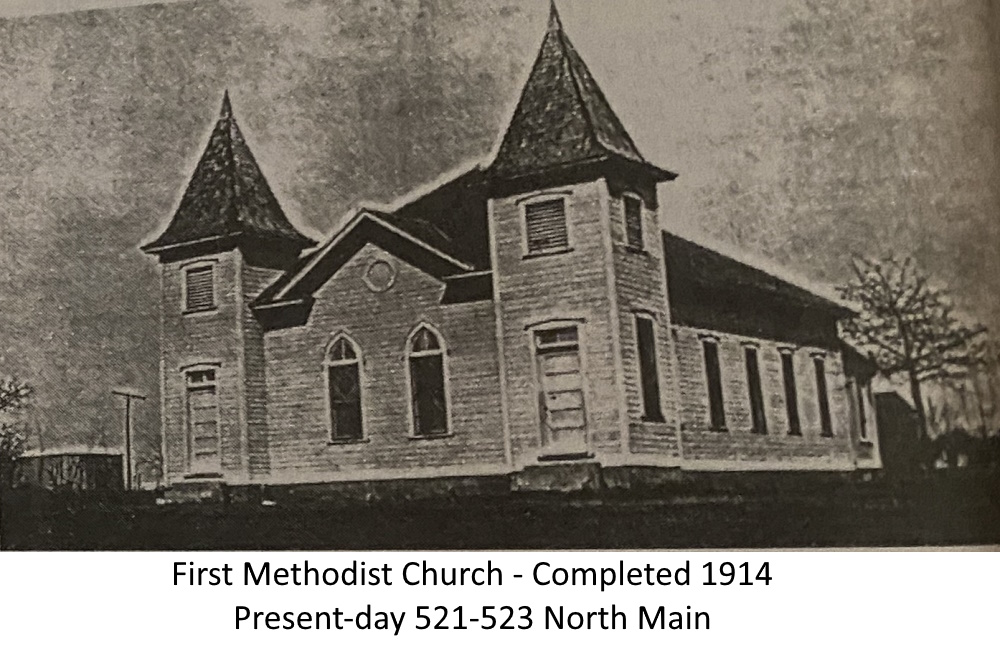
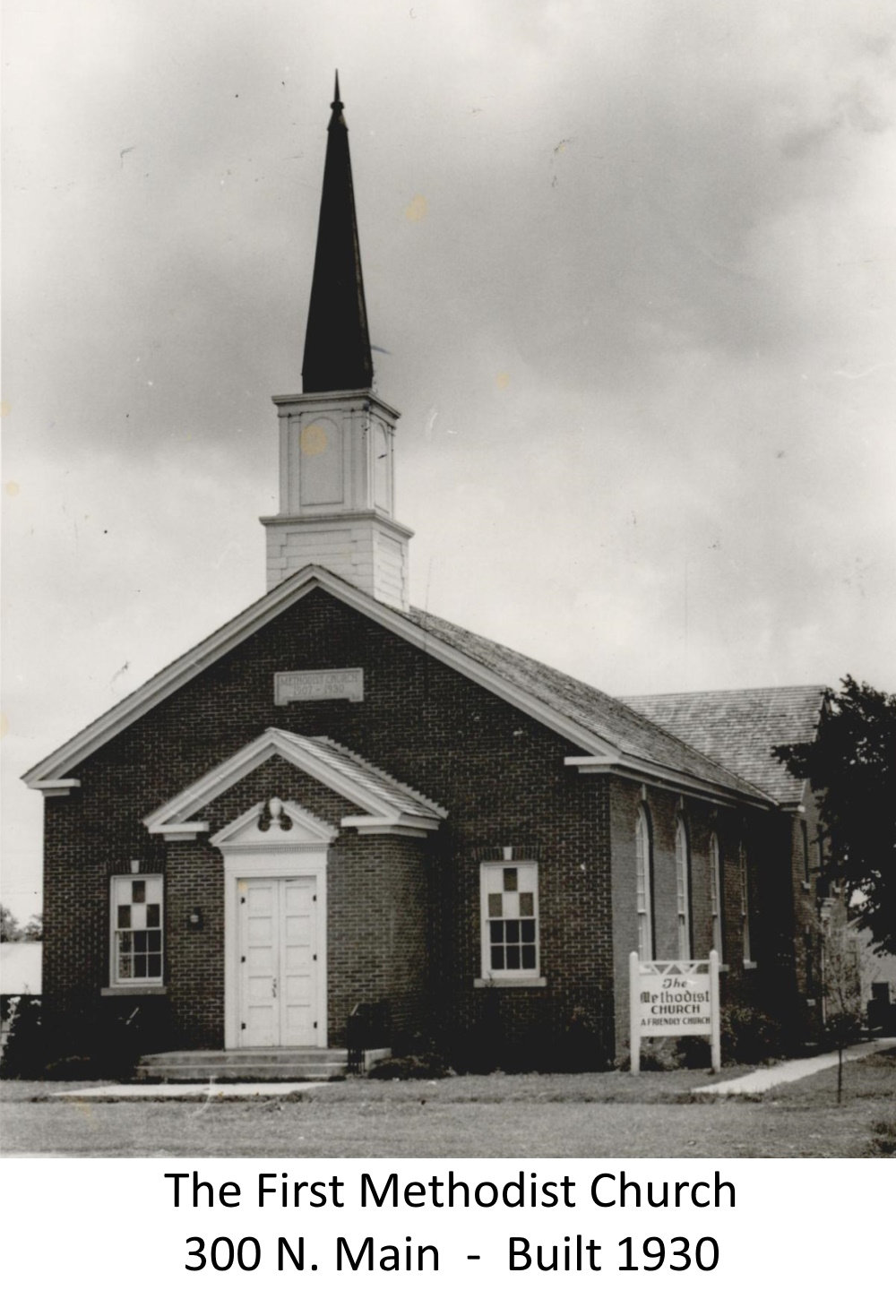
By 1929, the congregation had grown too large for the original building, so a new church was constructed at the corner of N.E. 3rd and Main Street. The new church cost $11,700 to build, and the mortgage was paid off in 1939.
T.J. Laws Insurance & Real Estate Building
Thomas Joseph “T.J.” Laws, was a long time resident and business leader of Blanchard. He was a very accomplished man, not withstanding his brush with federal law, with respect to a little bank fraud issue.
In 1910, Laws and his wife Ada came to Blanchard from Granite, where he took employment at the First National Bank as Cashier. Some four years after they settled in, in 1914, they built a residence on North Monroe, a two-story, seven-room house situated at the southeast corner of Northwest 5th and Monroe.
In May 1918, Laws established a real estate company with partner E.W. Powell, located upstairs in the First National Bank building. They called it “The Blanchard Realty Company”.
At some point, probably around 1930, Laws left the bank and started up an insurance agency.
In 1932, after achieving success in real estate, the insurance business, and the banking industry, a shadow fell over the enterprising man from Granite. He was indicted on six charges of violating national banking laws while serving as Cashier at the First National Bank of Blanchard. In 1933, he was convicted of these charges, but after considerable legal wrangling, he was given probation, assessed a fine of $500, and paid the same in court costs.
After his conviction and subsequent probation, Laws was through with the banking business. Still, in addition to his real estate and insurance businesses, he became interested in the Grady County Gin at Pocasset until it was dissolved. The Chickasha Cotton Oil and Mill took over its assets, and Law’s interest was transferred there.
In April 1937, Laws sold his insurance company to J.W. Fisher of the First National Bank of Blanchard. He acquired the Chickasaw Elevator and Grain Company on the Santa Fe Railroad near present-day S.E. 6th and Main.
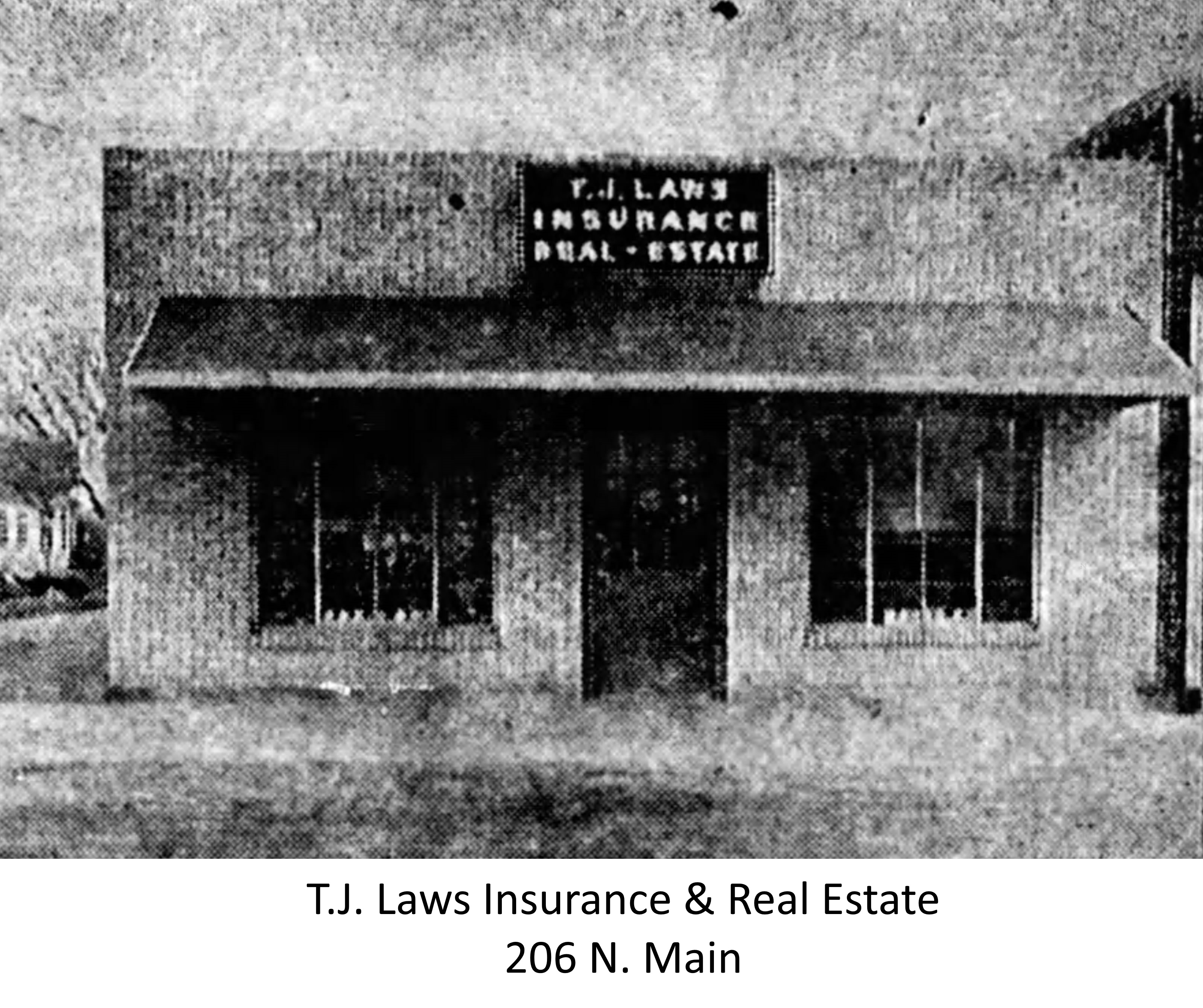
In 1949, Laws reentered the insurance bussiness and and set up shop at 206 North Main. In addition to insurance, he continued in real estate in Blanchard until 1957, when he sold out to Leroy and Kathleen Gibson.
After selling his business here, he and his wife moved to Oklahoma City, where they lived until Mr. Laws died in November 1964.
The building at 206 N. Main later became the office of the McClain County Health Department. When Pioneer Telephone Cooperative purchased the telephone company in 1982, they acquired this building, and in 1994 or 1995, Pioneer demolished the structure to make way for a new engineering building.
Oklahoma Central Railroad Depot
The Oklahoma Central Rairoad Depot in Blanchard was completed in July 1907. The following is from the July 22, 1907 edition of The Blanchard Record:
"The Oklahoma Central completed The Oklahoma Central completed their new depot here this week. The building is composed of three rooms, a ticket office, waiting room and store room. It has a very neat appearance and one that our town has a right to be proud of."
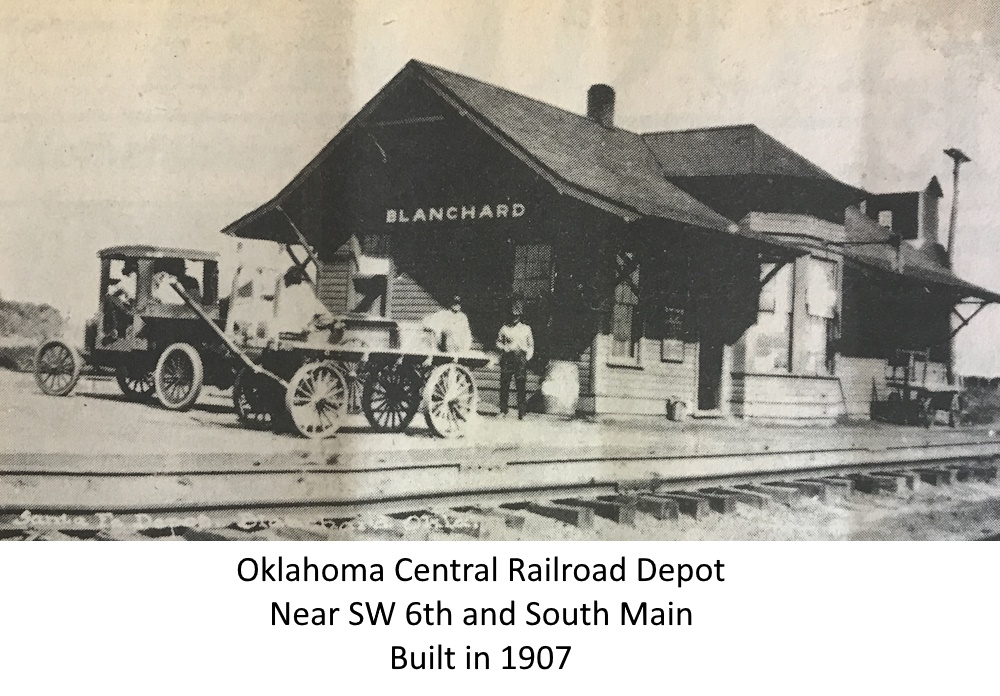
According to an article in the March 26, 1942, edition of The Blanchard News, the Santa Fe (formerly Oklahoma Central Railroad) Depot was closed on Saturday, March 21, 1942. The headline was: "Local Santa Fe Depot Closed Saturday."
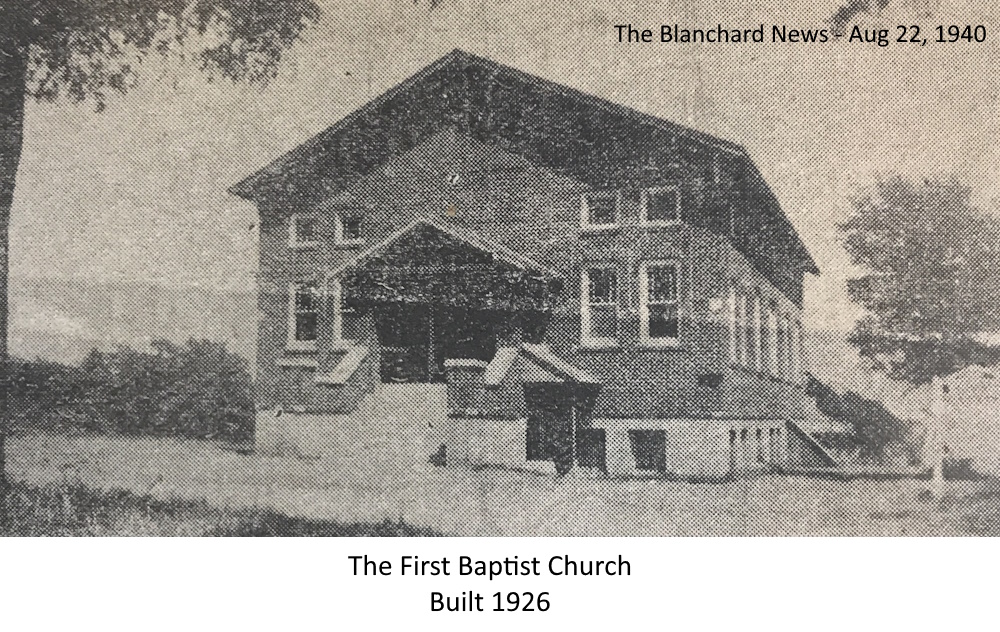
The First Baptist Church
This church building was built in 1926 at the southeast corner of Highway 62 (North 2nd) and North Jackson. This is the present-day location of O'Reilly Auto Parts.
W.C. Francis & Sons Ford Dealership
William Charles "W.C." Francis was born in Tupelo, Mississippi, on March 21, 1880. He moved to Blanchard before statehood, crossing the Canadian River near Lexington with his family in 1906, a year before the establishment of the townsite. He was 26 years of age.
Charles met Addie McGuinn in 1907 at Blanchard at an Odd Fellows dance and supper, and on August 1, 1909, the couple was united in marriage at Newcastle.
Before becoming a Ford dealer, W.C. Francis owned a restaurant and billiard parlor, was a county commissioner——for one term——and carried a rural mail route. In 1941 he was elected to the Blanchard school board and served for 14 years. He was also an active member of the Lions Club for several years.
Charles founded the Blanchard firm of W.C. Francis Ford and received his dealer franchise on Feb 2, 1915. After World War II, two of his sons, Rene and Herald, returned home and became partners with their father. The company name was changed to W.C. Francis & Sons at that time. They remained partners until Charles’ death in January 1964. After Charles passed, Rene and Herald operated the dealership until 1971, when the business closed.
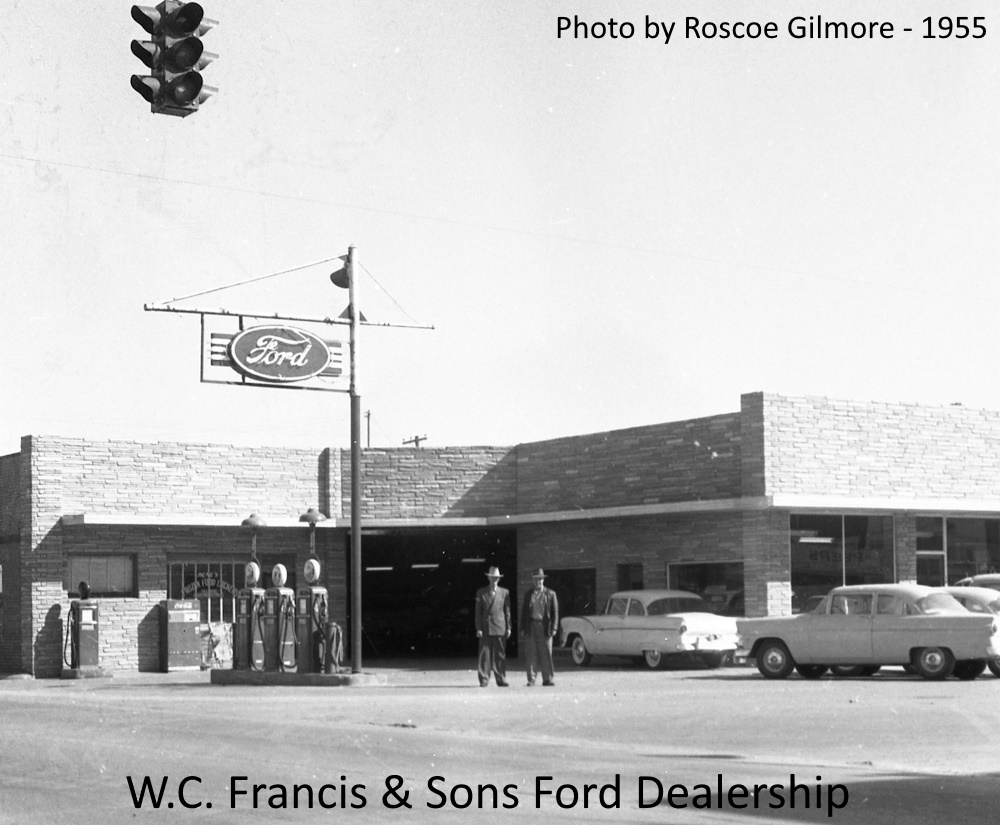
In addition to being a partner in the Ford dealership, Rene Francis owned and operated Rene’s Frozen Food Lockers in the adjacent space (in the portion of the building east of the gas pumps). Here customers could rent a locker to keep their frozen foods. Freezers were not yet common in most homes in those days. In the photo, the man on the left is W.C. Francis.
After the Ford dealership closed, this building, at 122 North Main, was sold to Sooner State Telephone Company in 1972 and the phone company converted the building to their business and operation offices.
After Pioneer Telephone bought out Sooner State in 1982, they demolished the building and built a new business office in it’s place. This new building is present-day Blanchard City Hall.
It is not known when this building was erected or when it was occupied by the Ford dealership.
Gilmore's Department Store & Gilmore - Agee Hardware
After living in Blanchard for nine years, Roscoe and Rosemary Gilmore purchased the J.B. Pilgrim store in December 1944 and opened Gilmore's Department Store during the first week of 1945. Gilmore had been the Carey Lumber Company's manager, located at the northwest corner of Broadway and Monroe in those days.
In January 1946, Roscoe's brother Robert Gilmore and his brother-in-law Emery Agee opened Gilmore-Agee Hardware and Appliances in the building next door north of Gilmore's Department Store. The Blanchard Shoe Shop and Roundup Cafe had previously been in this space.
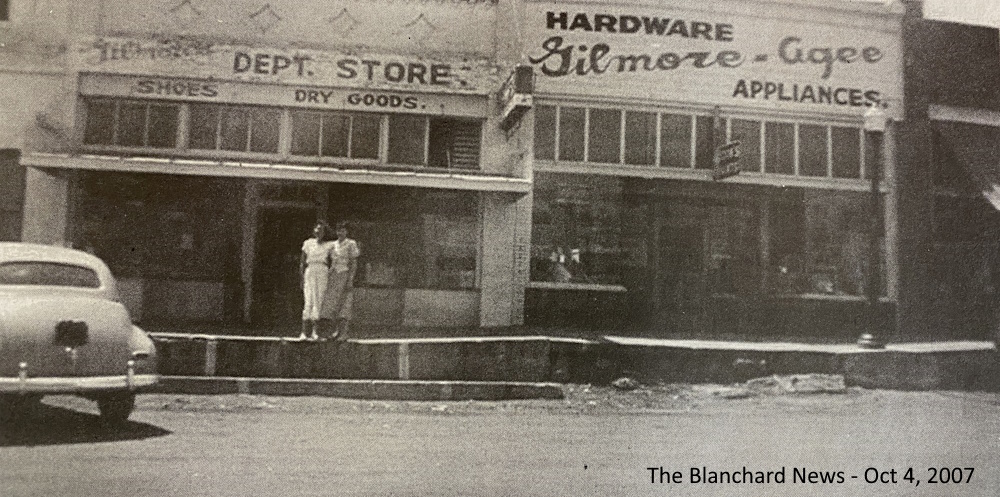
In January 1954, after eight years in business, Gilmore-Agee Hardware and Appliances closed, and Roscoe and Rosemary expanded their department store into the vacant space.
In December 1977, Roscoe and Rosemary sold their department store to Paula Richey and Troy and Vinita Moore. The new owners took charge of the store on January 1, 1978, exactly 33 years after the Gilmores opened their new business.
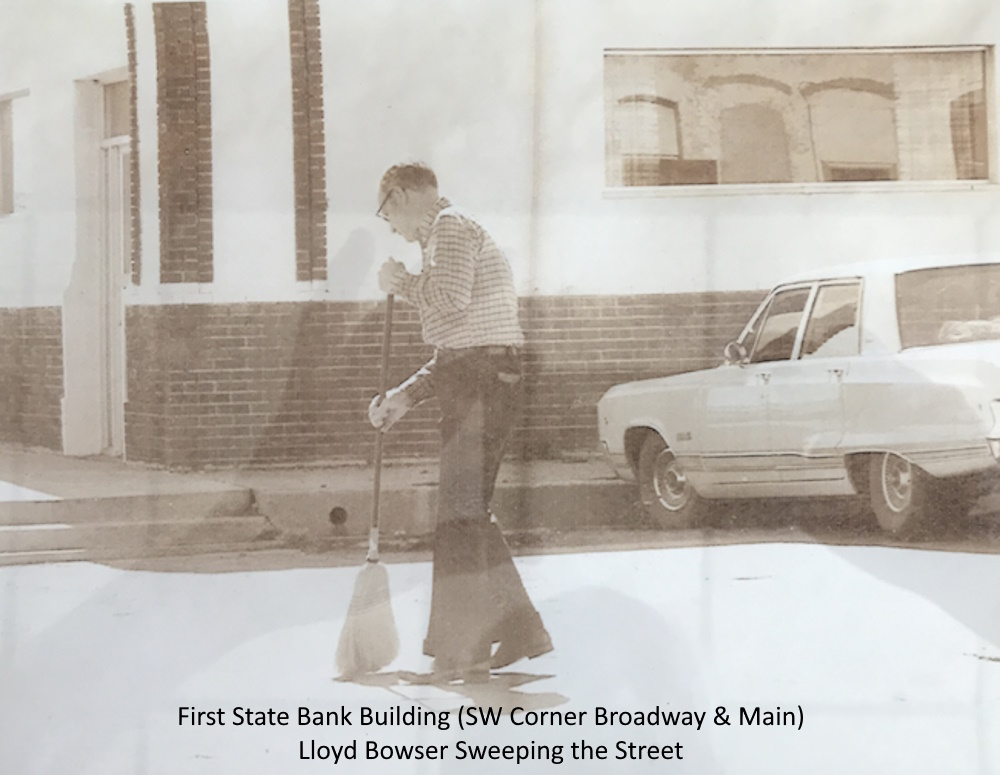
First State Bank Building (Originally First Bank of Blanchard)
One of the most intriguing stories of early Blanchard history is the one about Dwight Manny and Jere Pattison.
When researching the early days of Blanchard schools, I discovered two individuals who had come from Illinois to Oklahoma, searching for a suitable community to establish a new bank. The two men were Jere Pattison and Dwight Manny. One of these men, perhaps the best known of the two, Jere Pattison, was elected in 1907 to the Blanchard school board and was instrumental in establishing Blanchard’s first school building and school district. Pattison was also involved in the establishment of the Blanchard cemetery, a cemetery for Indians and whites, by working with the Five Civilized Tribes at Muskogee. In the early days the cemetery was known as the "B.Y.P.U Cemetery" (Blanchard Young People's Union).
Dwight Manny and Jere Pattison were cousins, related through Rockford, Illinois manufacturer Pells Manny (1802-1883), who was Jere’s grandfather and the father of his mother, Eliza Manny Pattison (1829-1905). Another child of Pells Manny was John Henry Manny (1825-1856), the inventor of the famous Manny Reaper and Mower in the early 1850s at Rockford, Illinois.
It is not altogether clear why these two enterprising gentlemen, both of very prominent families, chose Oklahoma, let alone the new town of Blanchard, to start up a bank. As far as this writer can tell, there was no previous connection to this part of the country for either Manny or Pattison. But came they did.
Jere Pattison and Dwight Manny arrived at Blanchard in early March 1907 and promptly applied for a charter for a bank that they intended to name “The First Bank of Oklahoma.” Their charter was received in May 1907, and The First Bank of Blanchard was born.
The bank operated under the name of The First Bank of Blanchard until January 1908, when another charter was granted to Pattison, Manny, and Charles Vincent for the First State Bank. At this time, The First Bank of Blanchard became The First State Bank and was reorganized. Pattison, Vincent, and Manny were elected President, vice president, and Cashier respectively.
In October 1913, Manny and Pattison sold their interests in the First State Bank and returned to their respective Illinois homes.

The First State Bank got a new building in 1926. The following is an article from the June 24, 1926 edition of The Purecell Register:
"The First State Bank has let the contract and work has begun on the new building at the corner of Main and Broadway. The present building will be torn down and a building twenty-five feet wide and a hundred and forty feet long, or deep, will be built.
The first sixty-seven feet will be occupied by the First State Bank and the bank building proper will be of matt face brick, stone and pebble dash stucco.
The rest of the building is to be occupied by C.C. Hester real estate, the Sam Ethridge barber shop and the U.S. Post Office
The post office will be twenty-five feet by forty-five feet with a big, airy lobby which will be open at all hours.
The rear of the building will be of square edge face brick. The building is to be completed by August 15"
Blanchard Snooker Parlor
Before 1945, The Blanchard Snooker Parlor at 117 N. Main was owned by Harrison Dilbeck, but in February 1945, he sold it to C.M. Tillerson who had moved here from Fort Worth. Then, in January 1950, Robert Bledsoe of Marlow purchased the snooker parlor. Bledsoe died in June 1950 and shortly after his death, J.G. "Doc" Griffin aaquired the business. Sometime between June 1 and July 6, 1961, Griffin sold it to Tommy Hodges.
In 1961, when Hodges took ownership of the pool hall, there was an ordinance on the city books that precluded the operation of domino tables within the city limits. The first order of business for Hodges was to make an application to the city council to have the rule revoked.
During the week of July 6, 1961, the council approved a measure that provided for license and regulatory measures for domino tables with a fee of $25 per year for three tables and $5 per year for each additional table.
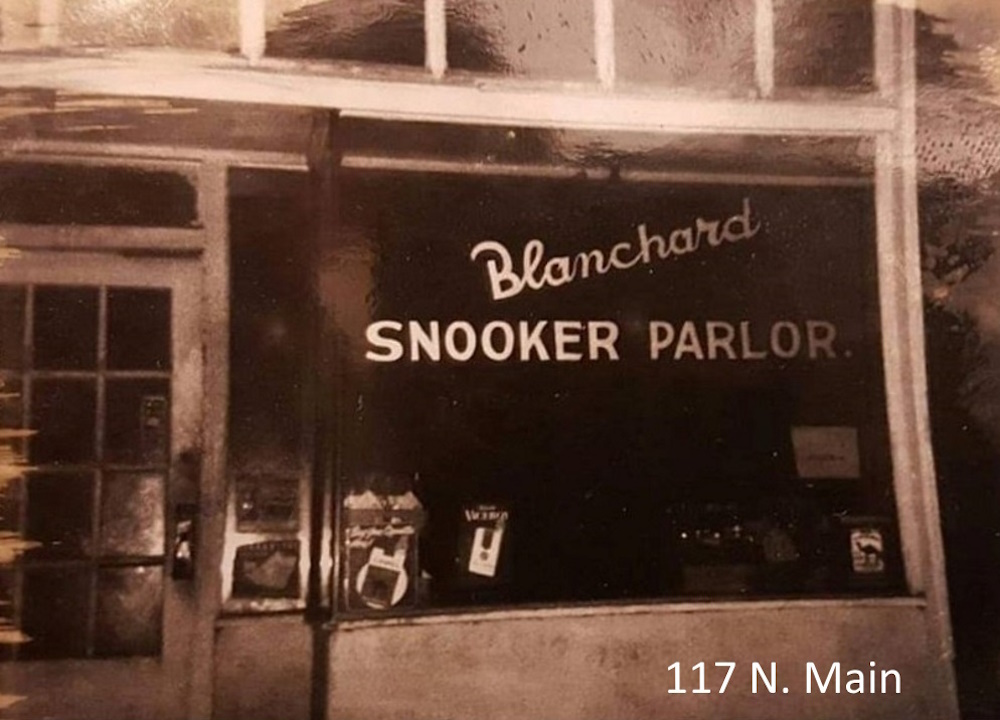
Harold Eisenhour called the pool hall "Hay Hauler's Headquarters". It is not known when it closed for business. Tommy Hodges passed away on November 22, 1969.
The Ben Franklin Store
Around 1945 M.D. Davis came to Blanchard from Dallas and purchased the Ben Franklin Store from John B. Edwards. Davis operated the store for three years before selling it to John and Dessie Dilbeck in December 1948. The store opened after the New Year 1949 under the management of the Dilbecks.
For the past four years, Dilbeck had been manager of the local yard for Carey Lumber Company. Upon his resignation, Herman Huffines, who had been with Carey for ten years, assumed the manager's duties.
Before selling the Blanchard store, Davis, who lived at 323 NE 4th (on the corner across from the Mac Starry Gym), purchased a variety store in Rush Springs, where he moved as soon as the deal was made. Arvil Patterson bought the Davis home.
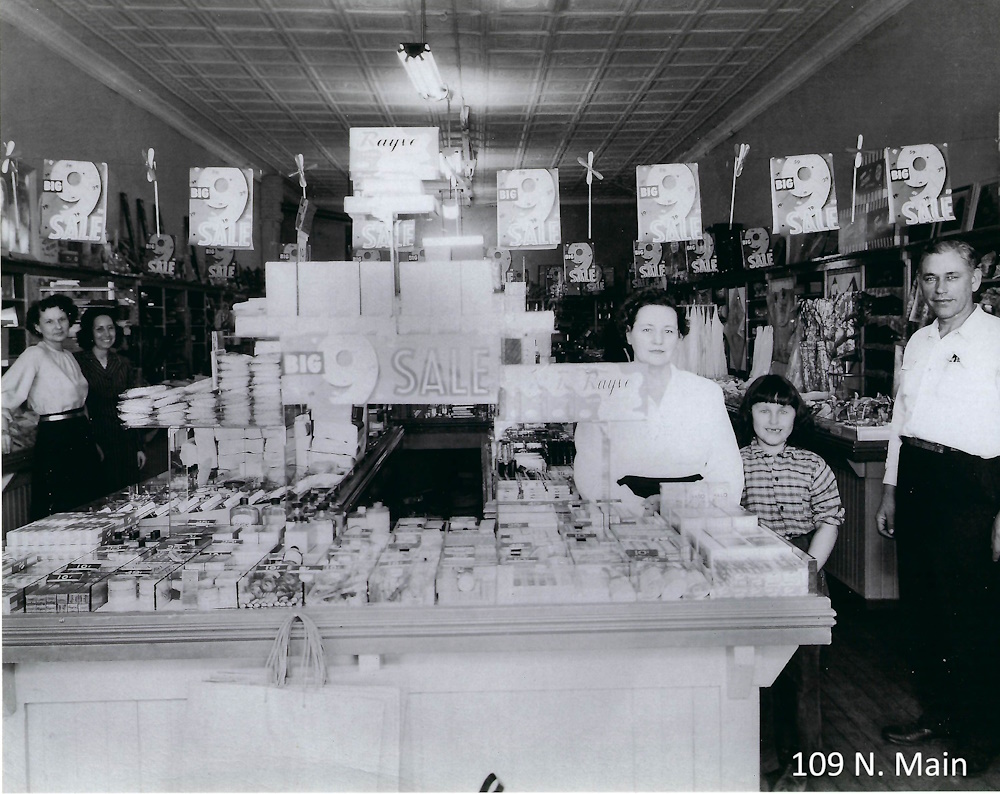
The above photo is of the inside of the Ben Frankline Store and is courtesy of Nina Dilbeck. From right to left: John Dilbeck, Nina, and Nina's Aunt Flossie (Carpenter) Dilbeck (married to John's brother, Harrison Dilbeck). On the left: Juanite (Sasser) Patterson (in white) (Arvils's wife) and Dessie Dilbeck.
This is a quote from Nina Dilbeck (Oct 2023): "My Dad bought the store, and my mother ran it for the next 35 or so years. My Dad spent most of his time on the sidewalk talking to whoever went by. After a year or so, they decided he might as well go back to being a carpenter, which he was good at."
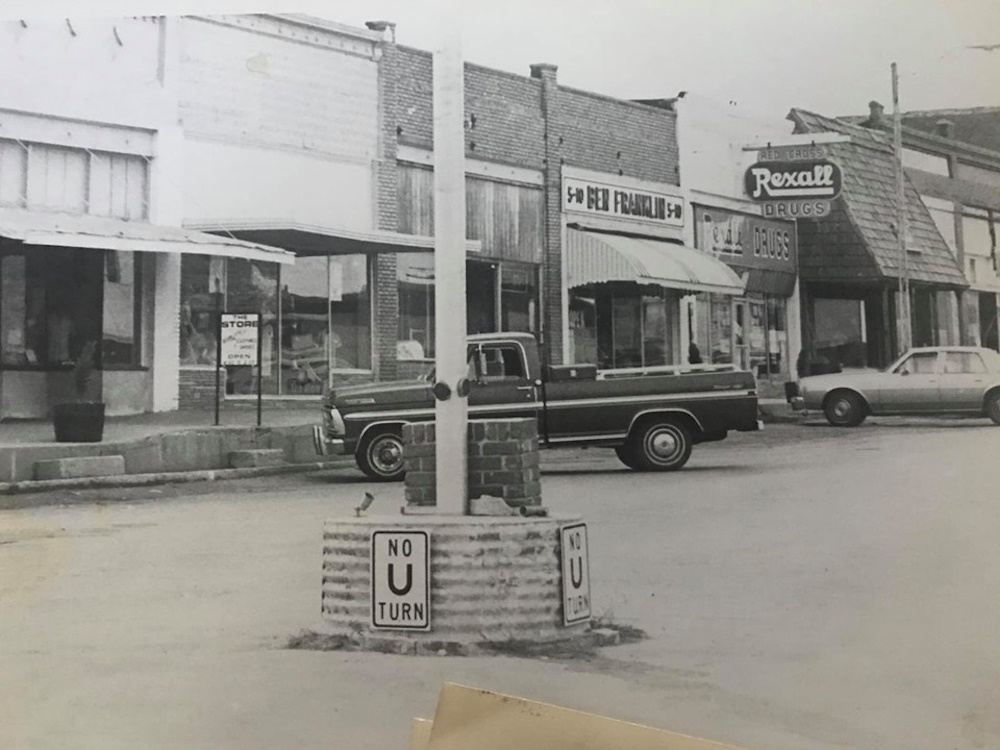
This is a partial shot of the west side of main showing the Ben Franklin Store. To the left (south) is the old hardware store and next to it is the former Gilmore's Department Store. The photo was taken after January 1, 1978 when the Gilmore store was sold.
According to the February 6, 1975 edition of the Blanchard News, Dessie Dilbeck sold the Ben Franklin Store to Mr. and Mrs. James Cunningham of Lindsay around the first of February.
Blanchard's First Post Office
On September 19, 1906, The Canadian Valley Construction Company held its first lot sale and R.E.L. McLain bought a lot on South Main (former location of the Carey Lumber Yard and the present location of Yarbrough and Sons) where he erected Blanchard's first building in just seven days. On September 26 he opened Blanchard's first store which was soon to house the post office and The Blanchard Record published by F.M. McFall.
McLain was confirmed as Blanchard's first postmaster on November 27, 1906, and the post office was established at McLain's store on December 16, 1906.
In addition to his postmaster responsibilities and running his grocery store, McLain owned a farm near Blanchard.
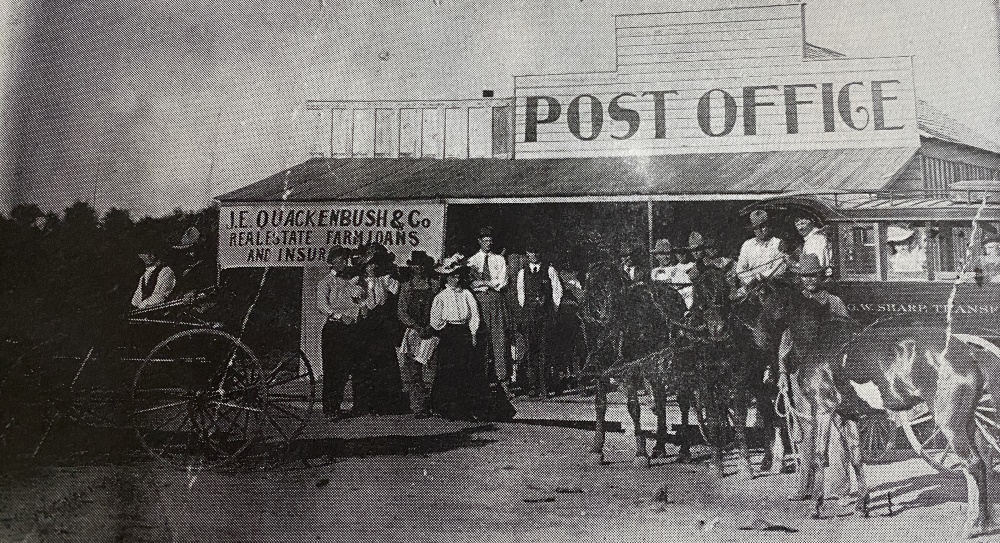
Notice the sign on the side of the horse-drawn carriage. It says "G.W. Sharp Transfer". Sharp was the proprietor of The City Livery, Feed and Sale Stable. Also J.E. Quackenbush operated his real estate and insurance business from here.
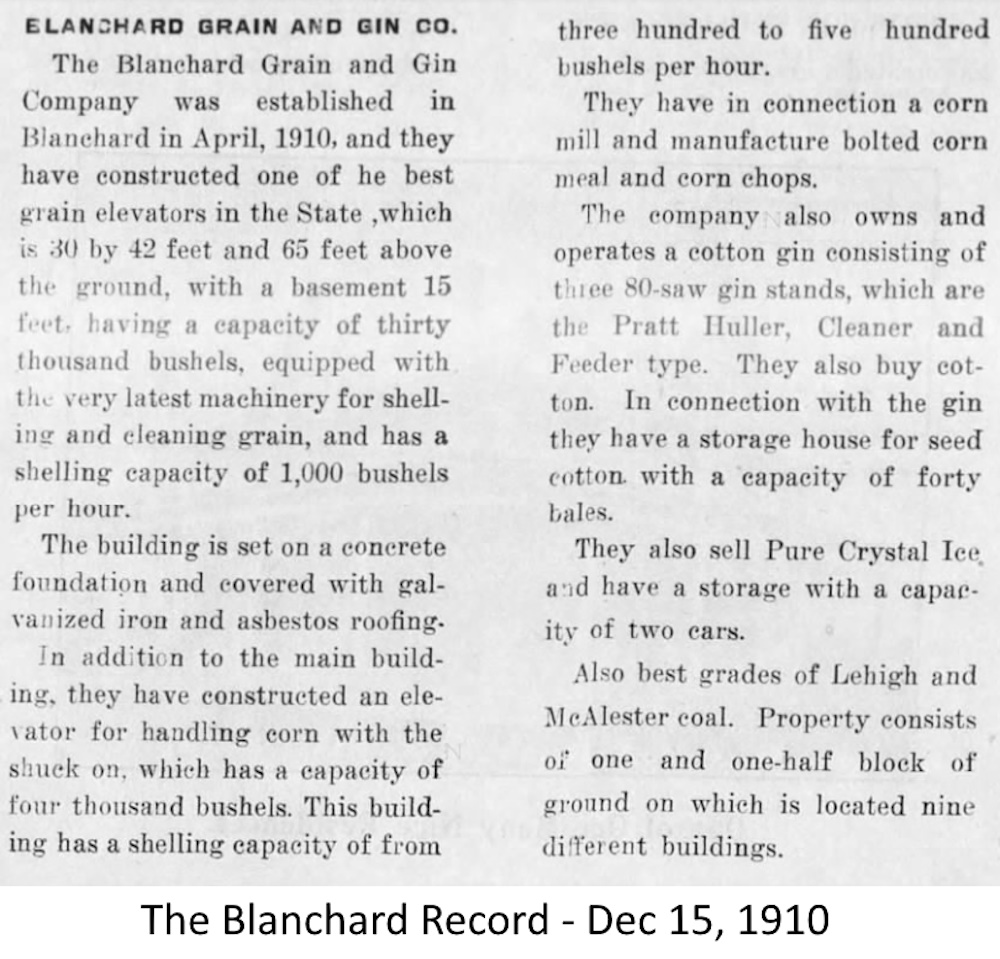
The Blanchard Grain and Gin Company

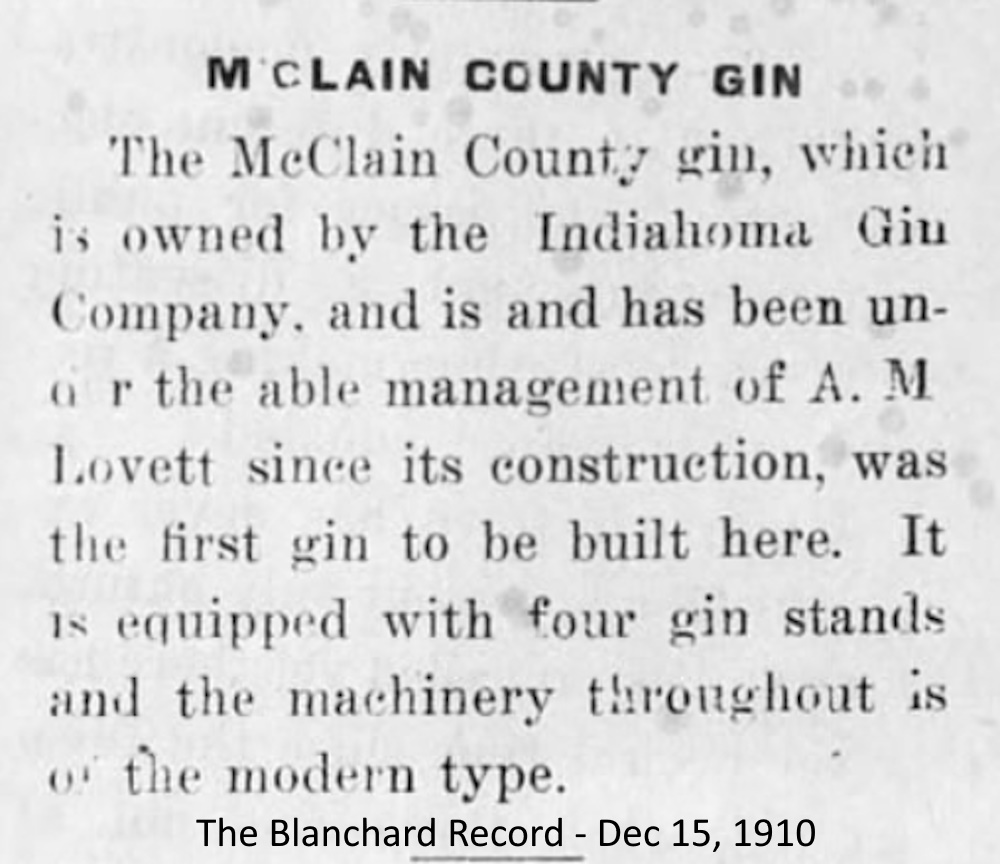
The McClain County Gin
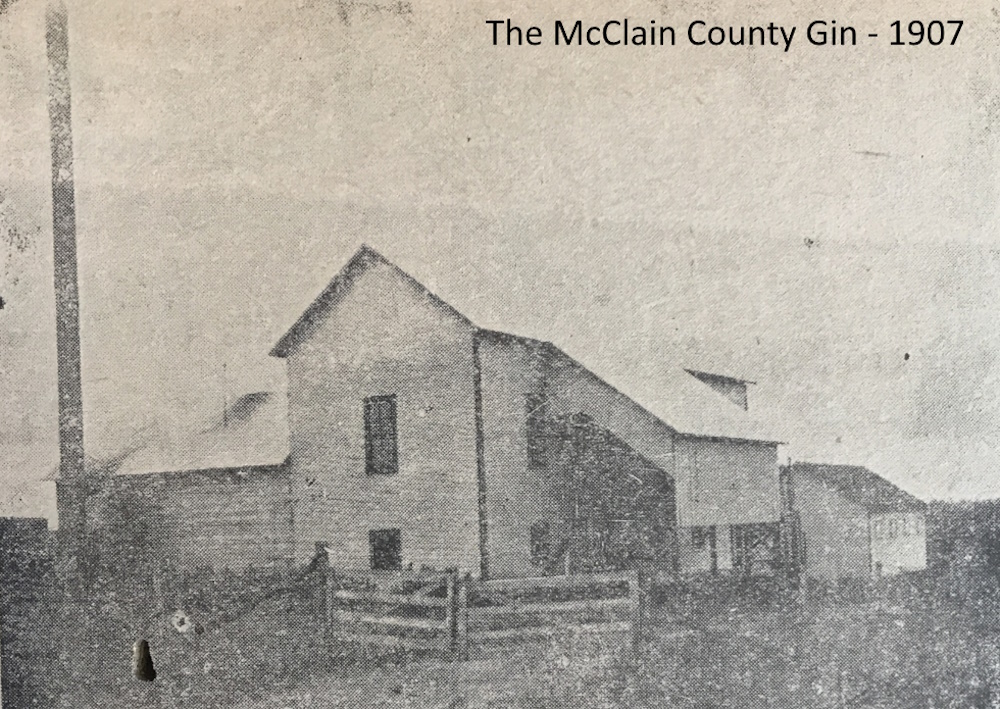
The McClain Gin first started ginning on Octomber 3, 1907.
C.F. Rathbun's Rose Bowl Fount
Charles Frederick "C.F." Rathbun arrived in Blanchard in 1910 and started up a jewelry, watch repair, and music shop, and later a confectionary. Around 1916, he moved his business into the space next door, south of 123 North Main (the building that currently houses Rhonda's Roses). He conducted his business at this location until 1941 when he built the Rose Bowel Fount.
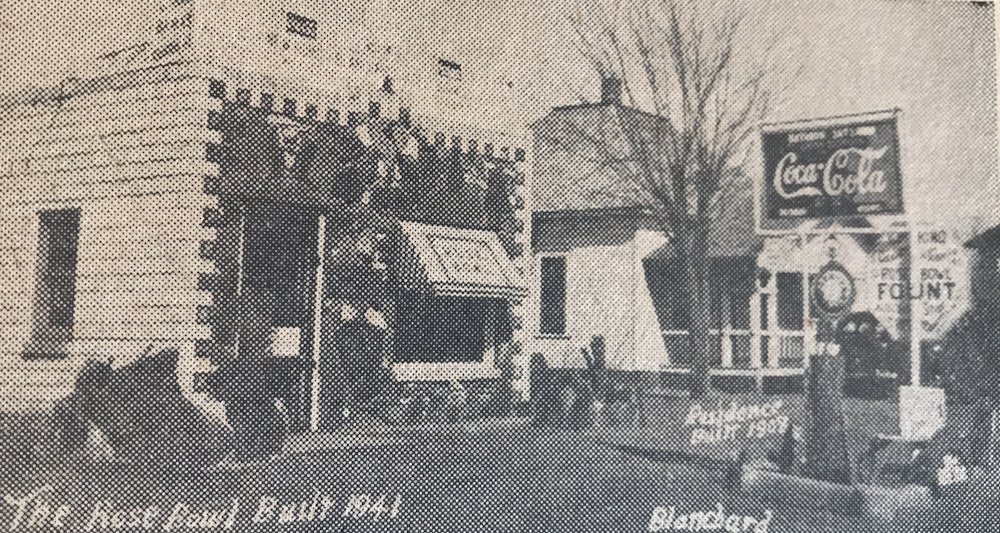
Rathbun built the Rose Bowl Fount and tourist courts next door west of his residence, which was at the NW corner of Highway 62 (NE 2nd) and Jackson. From his fount, he dealt in jewelry and repaired watches but primarily offered Coca-Cola, ice cream, and tobacco products, especially cigars. He operated the Rose Bowl until his death in 1948.
After Rathbun's death, F.T. and Docia Golden purchased his property, where they built a modern Sinclair service station and remodeled the tourist courts and the fount, turning the fount into the Golden Spot Cafe. The Goldens opened the station and cafe in May 1950.
References
[01]↩ Dr.
Albert W. Love [] was a cousin of Cora (Love) Hester. He was killed in a train wreck on the Santa Fe two miles south of Stillwater in February 1911.
[02]↩ Letter to the Editor by Michael and Paula Wier owners of the Subway Shop. []
[03]↩ Photo of Calvin Brickell and daughter Glenda in charge of two donkeys with an image of the Ritz in the background. []